The Science Behind CemeSeal

Understanding the permanent molecular transformation that sets CemeSeal apart from every coating, sealer, and topical treatment on the market.

Concrete Science

Concrete Mineralization

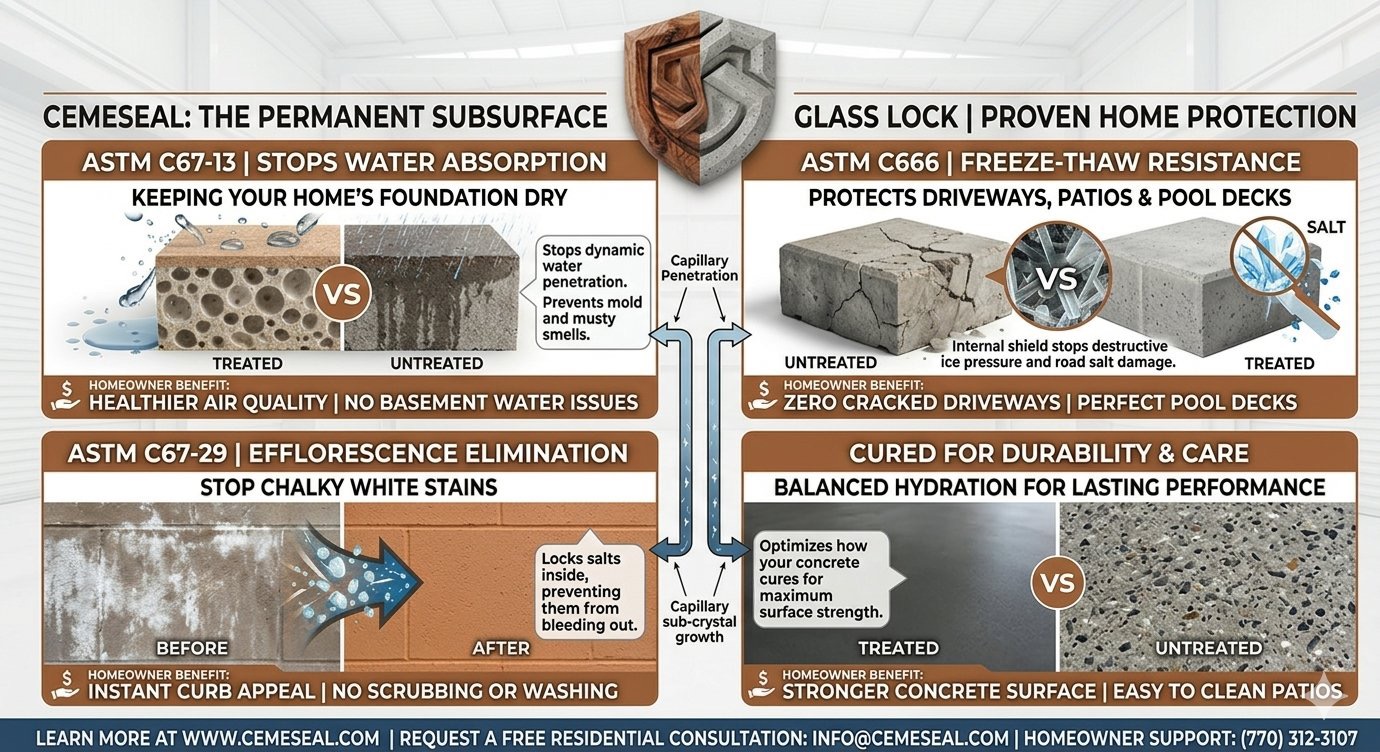
When CemeSeal is sprayed onto raw, unsealed concrete, it triggers a precise chemical reaction with the concrete matrix itself.

1
The Reaction
Concrete naturally contains Calcium Hydroxide (free lime) — weak, powdery, and water-soluble. This is why concrete dusts, chalks, and absorbs moisture.
2
The Transformation
CemeSeal sinks into the concrete pores and chemically bonds with free lime, creating Calcium Silicate Hydrate (CSH).
3
The Result
CSH is the exact same mineral crystalline structure that gives concrete its structural strength. CemeSeal fills internal microscopic voids, hardens the concrete skin, stops dust, blocks water intrusion permanently, and prevents saltwater spalling.
CemeSeal penetrates concrete and reacts with calcium hydroxide to form Calcium Silicate Hydrate, densifying the concrete from within
Cross-section comparison of natural hollow tracheid wood tubes versus silica-mineralized wood, showing biomimetic mineralization
Wood Science

Wood Petrification

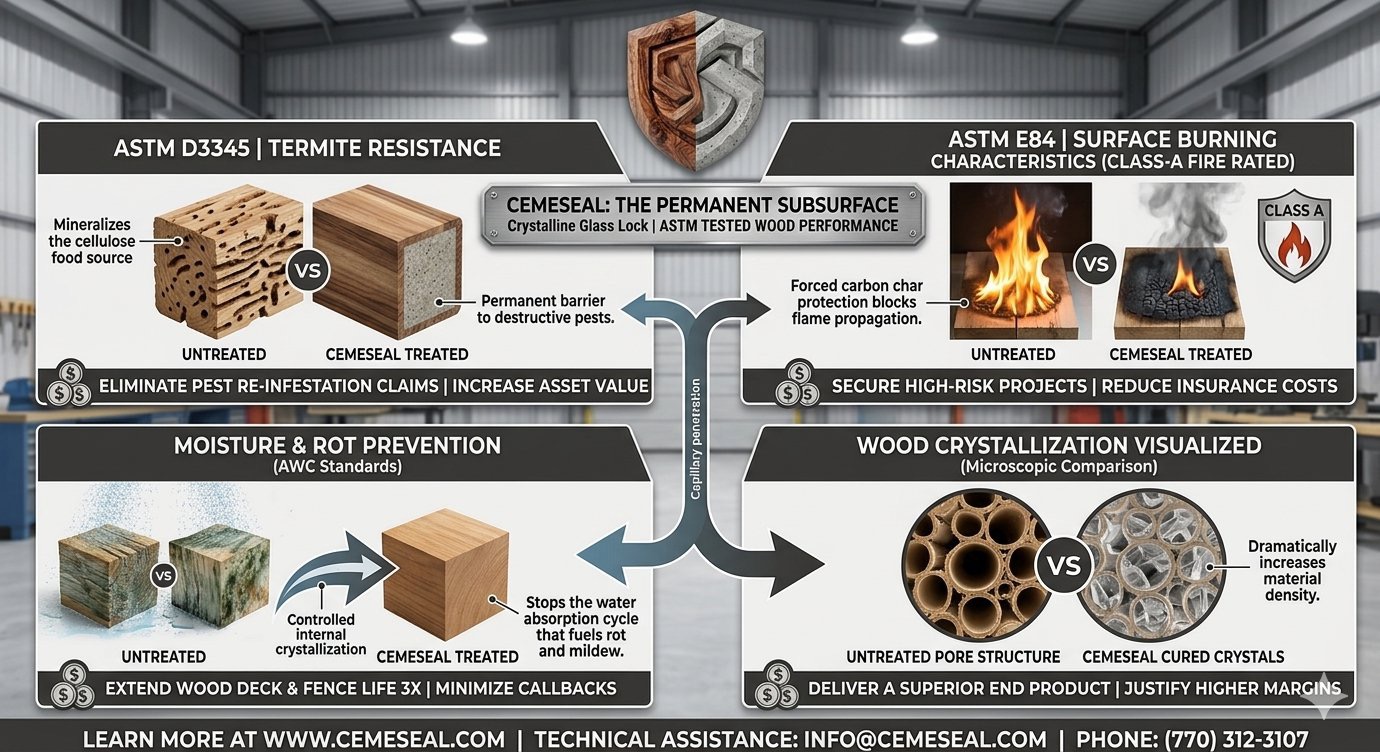
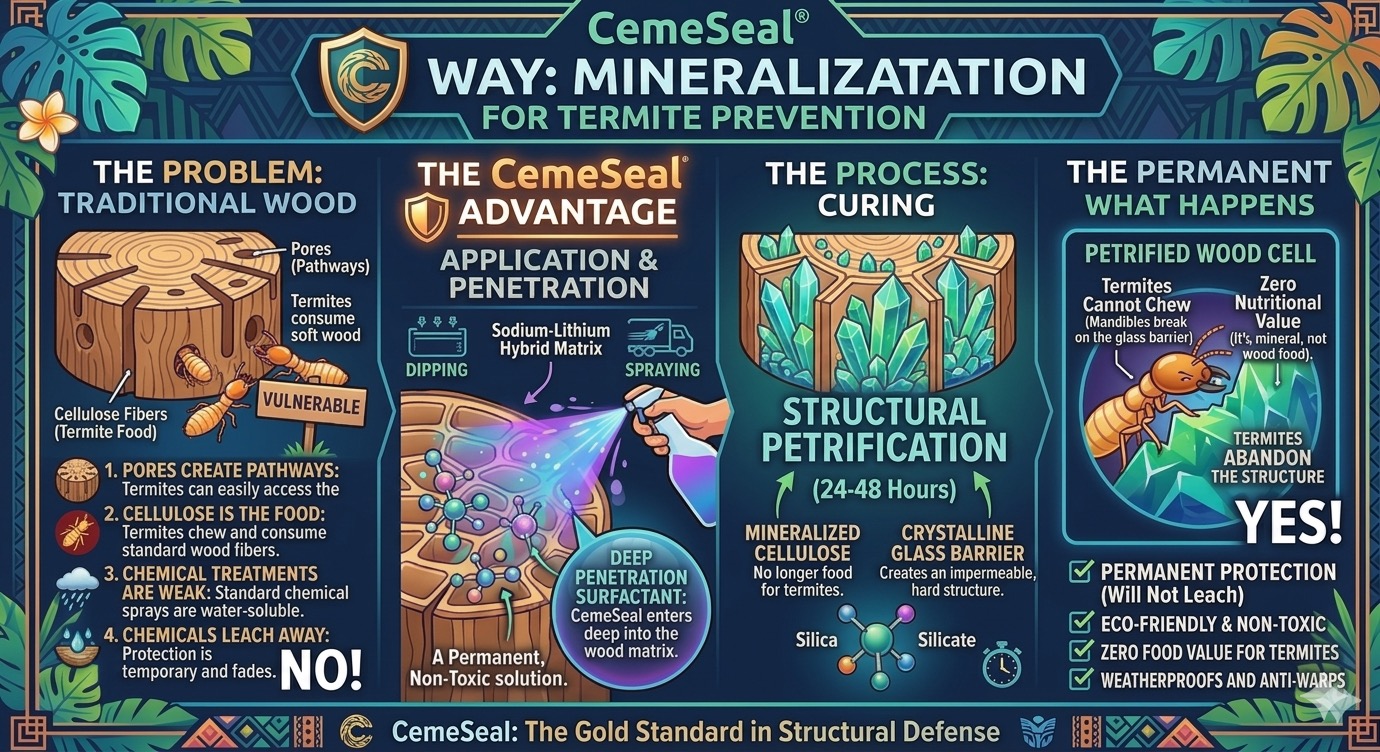
Wood is made of hollow organic tubes called tracheids. CemeSeal transforms these at the molecular level.
Application & Penetration
Sodium silicate solution fills the hollow tracheids throughout the wood grain.
Structural Petrification
The silicate reacts with CO₂ in the air to precipitate into solid, microscopic glass particles within 24–48 hours.
Permanent Result
Organic cellulose is mineralized into a petrified wood-stone composite. Crystalline glass fills the tubes, creating permanent protection that is eco-friendly and non-toxic.

The 3 Pillars of Permanent Protection

Scientifically verified and legally compliant claims backed by inorganic mineral chemistry.

Permanent Water Protection

CemeSeal completely penetrates micro-pores and cures into an insoluble silica crystalline glass structure, locking out structural water absorption from within. Unlike surface paint that cracks and peels under UV, a mineralized chemical matrix cannot flake off.

Permanent Organism Defense

Wood-destroying organisms like Formosan termites, powderpost beetles, and fungal rot require digestible organic cellulose to survive. When CemeSeal mineralizes that cellulose, it removes the food supply entirely. Termites cannot chew through hardened silica.

Highly Fire-Resistant

The silicate structure acts as a heat shield. It forces the outer surface layer to form an insulating carbon char rather than igniting, drastically slowing flame spread and raising the temperature required for ignition. Classified as Class A Fire Retardant.

Premium Service Add-On

The 4-Step Cracked Driveway Protocol

Our specialized “Stitch, Fill, and Seal” concrete restoration process transforms cracked driveways into permanently protected surfaces.

1
The Structural Chase (The Prep)
Technicians use a small angle grinder with a V-groove diamond blade to physically chase the crack, routing it out to clean up fractured edges. Then a Landa pressure washer blasts out all embedded dirt, roots, and loose debris.
2
The Molecular Prep (CemeSeal First)
While the cracked concrete channel is clean and slightly damp, the crew sprays CemeSeal directly into the raw interior walls of the crack. This hardens the weak, crumbling concrete inside the fracture from the inside out, creating a rock-solid structural bond for the filler material.
3
The Industrial Structural Fill
Once CemeSeal has absorbed, the crew bridges and seals the crack using premium, commercial-grade polyurethane or polyurea concrete joint sealant, color-matched to the driveway. For deep cracks, foam backer rod is pushed in first, then the sealant is smoothed flush.
4
The Final Flood Coat
Once the crack filler has fully cured, the crew performs the final all-over CemeSeal application across the entire driveway. This permanently hardens the rest of the slab, preventing new moisture from sinking in and halting future freeze-thaw cycles.